Showing posts with label Lab. Show all posts

Friday, December 14, 2012

Metal Reactivity Lab

Hey guys! So today in class we completed the Metal Reactivity Lab which had some pretty cool reactions in it. We started off the class, however, with watching some videos about Metal reactions and how the place on the periodic table corresponds with how strong a metal reacts with water (H2O). Both videos showed some pretty cool explosions and in case you want to watch it again, the episode of Braniacs is below even though everyone knows the explosions were fake :/

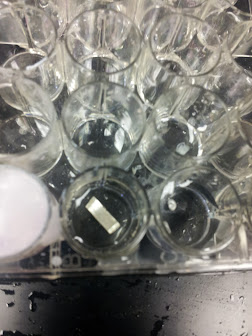
After the videos, we proceeded on with the lab. We began by taking a well plate and filling three wells with H2O, three wells with phenolphthalein, and three wells with HCl. Next, we took three pieces of magnesium ribbon, three pieces of aluminum ribbon, and three pieces of calcium metal and put one piece of each in their own wells in each of the liquids. We observed the reactions that took place and recorded them in a data table that will go into our lab books. It is a pretty straight forward lab and hopefully you understand the main idea that as you move down a column on the periodic table, elements become reactive in contrast to when you move across a period and the metals become less reactive.  The images below show what happened in the the experiment. There are no picture of the elements in phenolphthalein because no reactions occurred.  
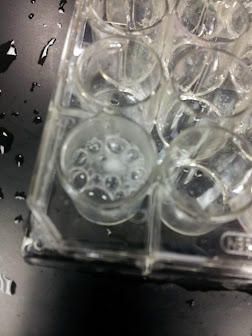
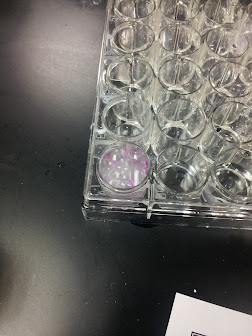
Magnesium in HCl
Calcium in HCl
Aluminum in HCl
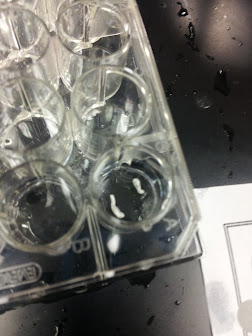
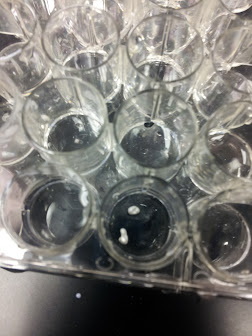
Aluminum in H20
Calcium in H2O
Calcium in H2O
Magnesium in H2O

I hope you guys have a good weekend and I would just like to remind you that the Alternate Universe Periodic table is due Monday along with this lab. The test is Tuesday and the Webassigns are due that days as well! 

Next scribe will be Chris!! Don't worry it's not that bad :P

Monday, November 26, 2012

Molar Volume of a Gas Lab

Today in class we worked on the Molar Volume of a Gas Lab. The goal of this lab is to measure the molar volume of Hydrogen gas at STP.

First, we measured out 10 mL of Hydrochloric Acid and poured it into the eudiometer.
Then, we filled up the rest of the eudiometer with water.
Next, we took a small strip of Magnesium and shaped it into a little ball and wrapped the Copper wire around it, which was placed in the stopper.
After, we put in the stopper and placed the eudiometer upside down in the stand, somewhat in a beaker half full of water.


The eudiometer's contents started to bubble, which is the evidence of the chemical reaction, and created the gas. The volume of the eudiometer minus the volume of the liquid left in the eudiometer equals the volume of the gas created by the chemical reaction.

In order to find the mass of the Magnesium strip, you have to use dimensional analysis to convert the length of the strip to grams using the conversion of 10 cm of Mg = 0.1407 grams.

The barometric pressure is 30.04 in Hg (inches Mercury), which you have to convert to millimeters.

Your water vapor pressure depends on whatever temperature you got.

Don't forget to use Dalton's Law of P(total) = P(H20) + P(H2), so that you can find the pressure of the Hydrogen gas to then find the molar volume. The total pressure is the barometric pressure, and the water pressure is your water vapor pressure.

The next scribe is Yada Thia.
Tuesday, September 18, 2012

Metal, Non-Metal and Metalliod Lab

By: Katie Hauldren


Today, to kick off the second unit and to start looking at the periodic table, we did the "Metal, non-metal and metalloid lab". Basically we were given 8 unknown elements and we recorded some of their physical and chemical properties. The goal of the lab was to try to figure out what element each unknown was.
 (Pictured below is all the unknown elements and two liquids that will help us in the chemical testing)
 

The physical properties of each element we recorded was their appearance, luster (if it is shiny or dull), malleability (brittle or bendable) and its electrical conduct. We used our eyes (obvi) to conclude their appearance and luster. We used a hammer and cutting board (pictured to left) to test each of their malleability.  Finally, we used a  electricity conductivity tester to find the levels of electricity (i had a picture but my sister deleted it...)
 
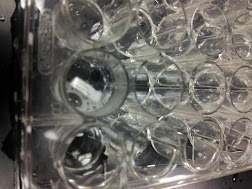
Then to test the chemical properties of the elements, we wanted to see how the elements would react with HCI and CuCI2. We used the plastic dish (photographed to the right) to carry out this part of the expirament. It had a "chemical reaction" if the element bubbled, changed color, changed temperature, in other words if the chemical didn't stay the same.


Today was a GR8 lab and I hope everyone learned a little more about some elements in the periodic table.

REMEMBER: Mr. Lieberman only put 7 elements on the back side of your lab so you are going to have to do some research to figure out the last one.

Homework: Do lab (Don't fret, its not due until Thursday.) and Web Assign 2.3 is up!


  peace love chemistry 


Next scribe is... Stacie Cho