Showing posts with label Unit 2. Show all posts

Tuesday, October 2, 2012

Percent Composition/ The Bubble Gum Lab

What's up guys! I hope you all enjoyed today as we stepped back into 90s and learned what NOT to wear to school by looking at some pretty ridiculous outfits (my clothing was a fine example). But in all seriousness, the bubble gum lab. Haha just kidding it was pretty fun to chew gum and listen to music in class. :P

Okay. So we started off class today by reviewing Avogadro's number (6.02x10^23) and how to use it as a conversion factor. SEE PICTURE BELOW


This is a pretty handy dandy model to remember so make sure you remember this!! 


PERCENT COMPOSITION
Today, we learned how to find the percent composition of an element and it's super simple. First, you have to find the molar mass of an element. For example, CuBr2 would be 223.55 grams. Then, you take the mass of each individual element and divide that by the total mass. For example, Cu would be 63.55 divided by 223.55. You then take that number and multiply it by 100 to find the percentage. SO EASY! You do that with the rest of the elements and that's it! 


The Lab
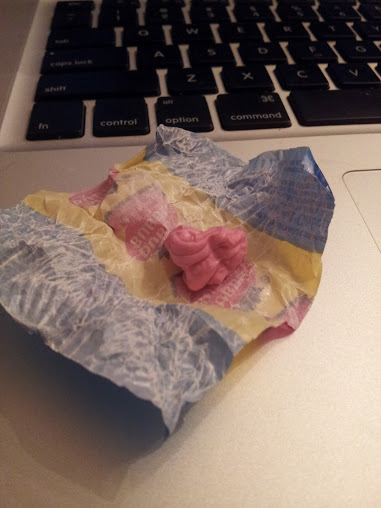
The next thing we did, was the amazing bubble gum lab. The goal is to find the % sugar in a piece of bubble gum and write an empirical formula for it. (GxSy) REMEMBER G is a FICTIONAL symbol for Gum. Get it? G for Gum? And S is a FICTIONAL symbol for Sugar. S for Sugar? Yeah, I know it's super clever. But the mass of the GUM is 513 g/mol and mass for SUGAR is 342 g/mol.

Basically we took a piece of gum, weighed it, chewed it, and weighed it again. Super simple I know. However, we then need to calculate the mass of the sugar in the gum, the gum before the chewing, the gum after the chewing without sugar, the % composition of the sugar, and find how many moles of sugar and gum there are. We needed to use the data and measurements obtained from weighing the gum to find that. Finally, we have to calculate the ratio between the moles of sugar to moles of gum which will then be the empirical formula. AKA the answer.
Reminders
  • Hydrate lab due tomorrow
  • Bubble gum lab due Thursday
  • % Composition worksheet due tomorrow
  • Test on Friday!
  • Do your WEBASIGNS!!!
  • DRESS AS YOUR FAVORITE 90s CHARACTER SO THE GENIE COMES OUT!!
NEXT SCRIBE WILL BE: BRAM!!!!!

Monday, October 1, 2012

Formula of a Hydrate Lab

HAPPY MONDAY!

In class:

We did the Formula Hydrate Lab (hence the title)
*Extra: Be aware of the spirit days this week as it is possible we might get a visit from the "Homecoming Genie" (I have NO idea what that means--but just show your spirit!)

For HW:

This lab (in the carbonless paper notebook of course) is due on wednesday.
DON'T FORGET: Test on Friday--Remember to do those webassigns!

Before Reaction

During Reaction

After Reaction


Let's get started.  So the purpose of this lab was to determine the amount of moles of water that are present in the compound per mole of Copper (II) Sulfate.

EQUATION OF Copper (II) Sulfate: CuSO4 * nH20 we are finding n in the lab)

Basically, we took blue hydrated Copper (II) Sulfate crystals, put them in a test tube, and heated them with a Bunsen burner until they turned white (allowing the water to separate from the substance). Here is a video of the process of the change from hydrated to anhydrous salt:


But, we had to do some weighing too.
  1. Finding the mass of the empty test tube
  2. Finding the mass of the test tube with hydrated salt
  3. Finding the mass of the test tube with anhydrous salt
AND some calculations after you collected TWO trials of the data:
  • Calculating the mass of the hydrated salt 
  • Calculating the mass and moles of water lost 
  • Calculating the mass and moles of anhydrous salt
  • calculating the ratio between moles of water and moles of anhydrous salt (this being your n from before)
Make sure to show all your work and answer all the questions at the bottom of the lab sheet!

**Don't forget--you should have used Avagadro's number at some point in your calculations.

Next Scribe will be: Rachel! :)


Monday, September 24, 2012

Acids

Today in Class We...

  1. Got Quiz 2.1 back
  2. Went over acids and naming them
  3. Reviewed naming Ionic and Covalent compounds
  4. Took Quiz over naming Ionic and Covalent compounds

Acids

Acids are substances formed when nonmetal ions combine with hydrogen. The hydrogen is written first in the compound and the naming is based on whether the anion (negative ion) is:

  • simple
  • polyatomic.

When acids ionize they form H+ ions.
  • Acids always contain hydrogen.
  • Example: Hydrogen and Chlorine:
               -HCl or Hydrochloric acid

Naming Acids                            *Trick to remember Acids: 'ate'ic- 'ite'is

If an anion does not contain oxygen-            
  • change the ending to "ic"                                                                                        
  • add prefix hydro
    • HF Hydrofluoric acid
If an anion does contain oxygen
  • "ate" becomes "ic"                                
  • "ite" becomes "ous"
Examples:  -H3PO4 - anion is phosphate = phosphoric acid
                    -HCN- hydrogen + cyanide = hydrocyanic acid
                    -H2SO3 - anion is sulfite = sulfurous acid

 Homework for tonight:

  • Naming Workshop worksheet
  • Study for naming quiz tomorrow *8 polyatomic ions need to be memorized
The next scribe will be Kevin L.


Saturday, September 22, 2012

Covalent Bonds

Important Things to Note About Covalent Compounds/Bonds
-Both the first and second elements of the compound are non-metals.
-The second element's name ends with the suffix -ide.
-When naming these compounds, we use Greek prefixes to determine how many atoms of an element are included in the covalent compound. ie. Dinitrogen (2) Pentoxide (5)
-The name of the first element can have any of the different prefixes except for mono-(one).
-The name of the second element can have any of the different prefixes.

Ionic vs. Covalent
-Ionic compounds consist of one metal element and one non-metal element, but covalent compounds consist of two non-metal elements. 
-The elements in an ionic compound must neutralize their charges, but elements in a covalent compound don't need to.
-Elements in ionic compounds don't use prefixes to determine the amount of atoms per element that are in the compound, but elements in covalent compounds use prefixes for their compound names. 


Prefixes for the Compound Names


Examples
-Sulfur Pentoxide - The formula would be SO5. The first element is S because we know that sulfur's atomic letter is S. The second element is O5 because we know that oxide is oxygen, and oxygen's atomic letter is O. Then since it has the prefix pent(a)-, we know that there's 5 oxygen atoms so you would put 5 as the subscript.
-Tetraphosphorus Trioxide - The formula would be P4O3. The first element is P4 because we know that phosphorus's atomic letter is P, then it's subscript is 4 because we know that there's 4 phosphorus atoms because of the prefix tetra-. The second element is O3 because we know that oxygen's atomic letter is O, then it's subscript is 3 because we know that there's 3 oxygen atoms because of its prefix tri-.
-You can find other examples in your notes from class.


Homework
-Covalent Compounds/Bonds Naming Practice worksheet
-Memorize the 8 polyatomic ions for Monday
-Study for the quiz on Monday

The next scribe will be Courtney S.

Thursday, September 20, 2012

Ionic Bonds

Lesson Overview:
-Ionic bonds are bonds made from sharing electrons which have to be ions of opposite charges
-Learning how to name compounds with metals and nonmetals
-Learning how to name compounds with transitional metals and nonmetals
-A short lesson on polyatomic ions

 http://www.chemistryland.com/CHM130/NomenclatureIonicIcon.jpg

 Vocabulary:
Ion- charged particles
Cation- positively charged ion
Anion- negatively charged ion 

1)Metals and Nonmetals:
   -First element must be metal
   -Second must be a nonmetal
   -When naming the whole compound, the second element (the nonmetal) must be changed to have an -ide at the end. (e.g. fluoride, oxide, etc.)
   -Charges have to cancel out

   Examples:
   -Naming
      NaBr= sodium bromide
      CaF2= calcium flouride
      BaO= Barium Oxide
   -Writing into Compounds
      Potassium Chloride= KCl (Potassium has a charge of 1+, and Chlorine has a charge of 1-)
      Sodium Sulfide= Na2S (Since sodium has charge of 1+, it needs two to balance with the sulfide which has a charge of 2-)

2)Transitional Metals and Nonmetals:
   -First element must be a transition metal
   -Second element must be a nonmetal
   -Transitional metals can have more than one type of charge, and they are represented by roman numerals. (e.g Cobalt has both a 2+ and 3+ type of charge, so Cobalt (II) and Cobalt (III)- respectively)
   -The first must be listed with a roman numeral which represents the charge. It is not a subscript!
   -Charges must cancel and the second element still has to end in -ide

   Example:
   -Naming
     FeBr3= Iron (III) Bromide (Since there are three bromide which combine to make a total charge of -3, there has to be be an iron with a charge of +3)
     NiS= Nickel (II) Sulfide (Sulfide has a charge of -2, so the nickel also needs to balance out the charges with a charge of +2)
   -Writing into Compounds
     Copper (I) Chloride= CuCl (Copper has a charge of +1, and chloride has a charge of -1)
     Iron (III) Oxide= Fe2O3 (since this iron has a charge of +3 and the oxygen has a charge of -2, there has to be a common multiple. So, there would have to be 2 iron molecules and 3 oxygen molecules)

3) Polyatomic Ions
   -combining atoms that carry a charge
   -The big eight to memorize
      Sulfate= SO4 (charge: 2-)
      Hydroxide= OH (charge: 1-)
      Ammonium= NH4 (charge: +1)
      Nitrate= NO3 (charge: 1-)
      Carbonate= CO3 (charge: 2-)
      Acetate= C2H3O2 (charge: 1-)
      Phosphate= PO4 (charge: 3-)
      Bicarbonate= Hydrogen Carbonate= HCO3 (charge 1-)

   Examples:
   -Formula
      Ammonium Sulfate=(NH4)2SO4
        Since Ammonium is NH4 with a charge of +1 and sulfate is So4 with a charge of 2-, there has to be be two ammonium ions. To represent two ammonium ions, put the ammonium in parenthesis and write another subscript.
      Iron Nitrate= Fe(NO3)3
        Iron has a charge of 3+ and nitrate has a charge of -1, so there has to be three nitrate ions to balance out with the 3+ charge of iron. 

The next scribe will be: Danielle S.

Wednesday, September 19, 2012

September 19th post

Today in class:
-watched a video about the elements : http://www.youtube.com/watch?v=d0zION8xjbM
-went over the notes for protons, neutrons, electrons, atomic symbols, and isotopes (last page of the note packet), and the second box of the first page (the one with the blank periodic table of elements)
-went over some of the lab

Some Notes (check your note packet for more) :
-Protons and neutrons have a relative mass of 1
-Protons determine the atomic number
-Neutron's charge is 0
-Electrons have negative charge and has a relative mass of 0
-Electron is equal to the number of protons in a neutral atom
-Mass number is the number or protons plus the number of neutrons
-Isotopes are two atoms of the same element


Homework:
-Isotopes in Chem Think
-Metals, Non-metals, Metalloids Lab
-Atomic structure worksheet
-Web Assigns (due 10/05)

Next scribe is: Yada Thia

Tuesday, September 18, 2012

Metal, Non-Metal and Metalliod Lab

By: Katie Hauldren


Today, to kick off the second unit and to start looking at the periodic table, we did the "Metal, non-metal and metalloid lab". Basically we were given 8 unknown elements and we recorded some of their physical and chemical properties. The goal of the lab was to try to figure out what element each unknown was.
 (Pictured below is all the unknown elements and two liquids that will help us in the chemical testing)
 

The physical properties of each element we recorded was their appearance, luster (if it is shiny or dull), malleability (brittle or bendable) and its electrical conduct. We used our eyes (obvi) to conclude their appearance and luster. We used a hammer and cutting board (pictured to left) to test each of their malleability.  Finally, we used a  electricity conductivity tester to find the levels of electricity (i had a picture but my sister deleted it...)
 
Then to test the chemical properties of the elements, we wanted to see how the elements would react with HCI and CuCI2. We used the plastic dish (photographed to the right) to carry out this part of the expirament. It had a "chemical reaction" if the element bubbled, changed color, changed temperature, in other words if the chemical didn't stay the same.


Today was a GR8 lab and I hope everyone learned a little more about some elements in the periodic table.

REMEMBER: Mr. Lieberman only put 7 elements on the back side of your lab so you are going to have to do some research to figure out the last one.

Homework: Do lab (Don't fret, its not due until Thursday.) and Web Assign 2.3 is up!


  peace love chemistry 


Next scribe is... Stacie Cho